
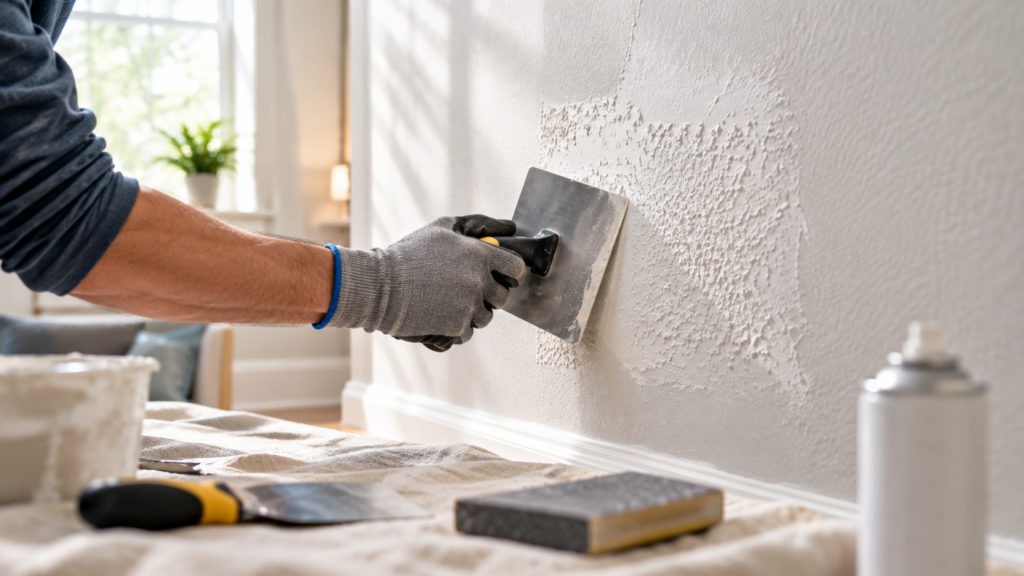
How to Match Drywall Texture After a Repair
You patched that hole, and now the spot stands out on the wall like a bandage. Fixing the damage is the easy part. Knowing how to match drywall texture after a repair is what makes the wall look like nothing ever happened.
The good news is that you don’t need fancy skills. Whether you tackle it yourself or hire someone for drywall repair, it helps to know what a good blend looks like. A few basic supplies, some patience, and a little practice will get you a patch your guests won’t notice.
Why Patches Show Up Even When They’re Smooth
Light is usually the culprit. Texture catches light in tiny bumps and shadows, so a patch that’s too flat or too rough looks different from the wall around it. Fresh joint compound also soaks up paint differently than old drywall, which leaves a dull halo around the repair. Learning how to match drywall texture after a repair starts with fixing both problems.
Step One: Identify Your Wall Texture
Hold a flashlight close to the wall and look along the surface. The shadows will show you the pattern. The most common types are:
- Orange peel: small, even bumps, like the skin of an orange.
- Knockdown: splotchy peaks that have been flattened with a knife.
- Skip trowel: flat, overlapping swoops that look hand-laid.
- Popcorn: a bumpy, cottage-cheese look, mostly on ceilings.
- Smooth: no visible pattern at all.
Take a photo of your wall for reference. One safety note: popcorn ceilings installed before the 1980s may contain asbestos, so have a sample tested before you sand or scrape anything.
What You’ll Need
- Pre-mixed joint compound
- 6-inch and 10 to 12-inch drywall knives
- Sanding sponge
- Spray texture can (or a hopper gun for bigger jobs)
- Primer and matching paint
- Drop cloth and painter’s tape
- A piece of cardboard for practice
How to Match Drywall Texture After a Repair: Step by Step
- Finish the patch first. Tape, mud, and sand until the repair sits flush with the wall. Texture won’t hide a bump or a dip.
- Prime the patch. Primer seals the compound so the texture and paint dry evenly.
- Practice on cardboard. Spray or apply a test patch and compare it to your wall. Adjust before touching the real thing.
- Apply the texture. For orange peel, use short, light bursts from about 12 to 18 inches away. For knockdown, spray or flick on thinned compound, wait until the surface loses its wet shine (30 seconds to 2 minutes for a spray can, longer for hand-thinned compound), then lightly flatten the peaks with a knockdown knife. For skip trowel, spread thinned compound in loose, overlapping strokes.
- Feather the edges. Work outward 4 to 6 inches past the patch so there’s no hard line where new meets old.
- Let it dry fully. Spray texture can be paint-ready in about 30 minutes, but give thicker or hand-applied texture a full day. Then prime again if needed and paint the whole wall corner to corner, not just the patch.
Texture Types at a Glance: Depth, Method and Prep
Each texture has its own depth, spray method and surface prep, and mixing them up is the quickest way to a visible patch. This table pulls those details together for the three most common textures, using manufacturer instructions and the Gypsum Association’s GA-214 finish levels.
|
Texture |
Typical Depth |
Application Method and Timing |
Surface Prep Under It (GA-214) |
|
Orange peel |
1 to 2 mm |
Sweeping bursts from 12 to 18 inches (30 to 45 cm), built up in thin layers. No flattening step. Ready for paint in 30 minutes or more |
Level 4, for light textures |
|
Knockdown |
2 to 4 mm |
Same spray, then flatten the peaks with a water-dipped putty knife: right away for fine, 30 to 60 seconds for medium, 1 to 2 minutes for heavy. Ready for paint in 30 minutes or more |
Level 3, for medium textures |
|
Popcorn |
3 to 8 mm |
Build in layers with 5 minutes between coats. Painting is optional after 30 minutes |
Level 3, for heavy textures |
|
Smooth |
None |
Skim-coat the full wall section with several thin coats of compound, sanding between coats. Slow work that often needs a pro on larger areas |
Level 4 for flat paint; Level 5 for gloss, non-flat or dark paint, or harsh lighting |
Source: DAP, “How to Match & Repair Wall & Ceiling Textures” (March 24, 2025) for depths, spray distance and timing; Gypsum Association, GA-214 Levels of Finish for Gypsum Panel Products (2021) and CertainTeed’s summary of GA-214 for finish levels. DAP’s figures apply to its water-based 2-in-1 spray textures, so other brands and hand-applied compound can differ; follow your product’s label. DAP also warns that popcorn texture installed before the 1980s may contain asbestos. Standards get updated, so check gypsum.org for the current GA-214 edition. Last checked October 2026.
Mistakes That Make Patches Obvious
If you’re still figuring out how to match drywall texture after a repair, watch out for these common slip-ups:
- Too much texture at once. You can always add more, but you can’t easily remove it once it dries.
- Skipping primer. The patch will look dull or blotchy under paint.
- Painting only the patch. Even matching paint looks different on a small, fresh spot. Paint the full wall.
- Rushing the dry time. Wet compound shifts and sags. Be patient.
When It’s Time to Call a Pro
Some jobs are worth handing off. Large areas, ceilings, water-damaged drywall, and hand-troweled textures are hard to blend. If you’ve tried to match the texture on your own and the patch still shows after a second attempt, a professional can save you time and frustration. Homeowners who search for drywall repair in Alpharetta often do so after a DIY patch didn’t blend, and that’s nothing to feel bad about. Not sure which way to go? Here’s how to weigh DIY vs. professional drywall repair before you decide.
Why Choose JustFixToday
Texture matching is part science, part touch, and it takes practice to get right. For drywall repair in Alpharetta, JustFixToday focuses on repairs that disappear into the wall instead of leaving a visible mark. Here’s what you can expect:
- Experienced technicians who match your existing texture by eye and by hand
- Clean, careful work that protects your floors and furniture
- Clear communication and honest quotes, with no surprise add-ons
- Repairs finished from patch to paint, so you don’t have to chase down multiple people
Curious about pricing first? See what drywall repair typically costs in Alpharetta, GA.
We treat your home the way we’d treat our own. Knowing how to match drywall texture after a repair is what separates a patch you notice from one you never see, and it’s the part we take the most pride in.
Final Thoughts
A patch that blends in comes down to a few simple habits. Identify your texture first, practice on cardboard, blend a few inches past the edges, and paint the whole wall. Rushing any of those steps is what makes a repair show.
Take your time, and don’t feel bad if the job turns out bigger than expected. If the patch still stands out after a second try, a professional can usually fix it in a single visit. For homeowners in Alpharetta, the JustFixToday team is a call away and happy to take over.
Frequently Asked Questions
1. What’s the easiest texture to match?
Orange peel is usually the most forgiving, especially with a spray can. Smooth walls are easy to get flat but take more sanding to get invisible.
2. Can I use a spray can for any texture?
Spray cans work well for orange peel and light knockdown. For skip trowel or heavy patterns, hand application with compound gives a better match.
3. How long should I wait before painting?
Spray texture can be ready for paint in about 30 minutes, but thicker or hand-applied texture and humid rooms need longer. When in doubt, wait a full day.
4. Why does my patch still show after painting?
Usually the surface wasn’t primed, or only the patch was painted. Prime first, then paint the entire wall for an even finish.
5. Do I need to texture the whole wall?
No. Blend the texture outward past the patch edges, then paint the whole wall. The texture only needs to match, not cover everything.
Ready for a Wall That Looks Like It Was Never Damaged?
If you’d rather skip the guesswork, let the team at JustFixToday handle it. Contact us today for a free quote on drywall repair in Alpharetta, and we’ll make your patch blend in so well you’ll forget where the damage was.