
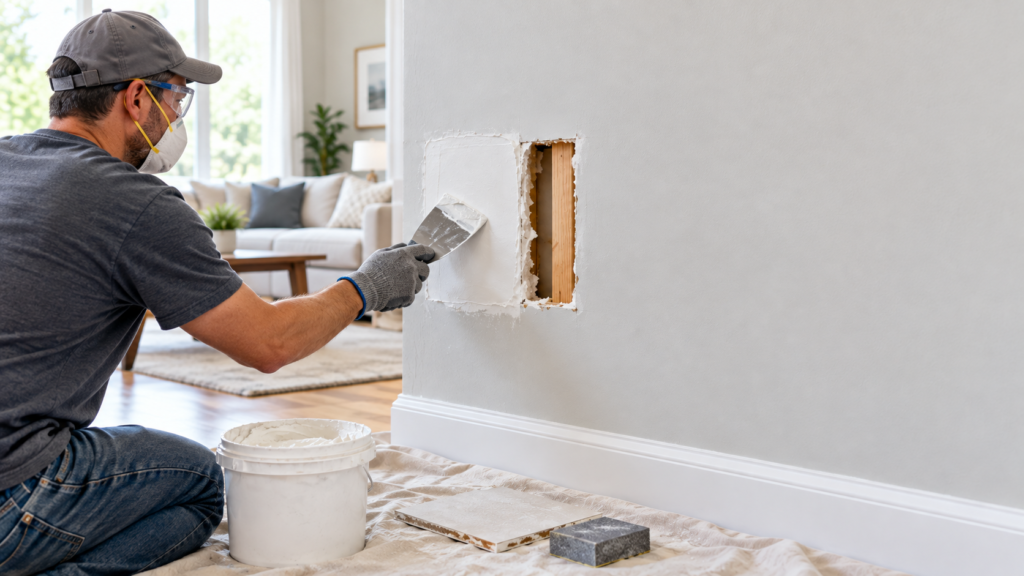
Cracks, dents, stains, a hole from a swinging door handle. Drywall takes a beating in every home, and most of us just want to know one thing: will a quick patch do, or does the whole panel have to go? So, when should drywall be repaired instead of replaced? The answer depends on how big the damage is, what caused it, and whether moisture is involved. This guide walks you through it in plain language so you can make a smart call and avoid paying for more work than you need.
When Should Drywall Be Repaired Instead of Replaced? A Simple Rule of Thumb
In most cases, repair makes sense when the damage is small, dry, and sitting on the surface. Replacement makes sense when the damage is large, wet, or has weakened the board itself.
Here is an easy way to think about it. If the panel is still firm and flat, it can usually be saved. If it feels soft, crumbly, or is sagging, it is time to swap it out.
Signs Your Drywall Can Be Repaired
Most everyday wall damage is minor, and a good repair can make it disappear completely. These are the signs that tell you a patch is all you need.
Nail pops and screw pops
Small round bumps that push through the paint usually appear when the wood framing dries out and shifts a little. The board itself is fine. The fastener can be pulled tight again, then the spot is covered with joint compound, sanded smooth, and painted.
Small dents and dings
Door handles, furniture, and flying toys all leave dents behind. If the paper is not torn and the board feels firm, a couple of thin coats of joint compound will fill the dent. Thin coats work better than one thick one because they dry evenly and sand down cleanly.
Hairline cracks
Thin cracks at the corners of doors and windows, or along the seam where a wall meets the ceiling, often come from normal settling and changes in temperature and humidity. If the crack is thin, dry, and not growing, fresh tape and compound will usually take care of it.
Small holes
A doorknob hole or the gap left by a removed wall anchor does not mean the whole panel has to go. Holes up to about 6 inches can generally be covered with a self-adhesive mesh or metal patch, then finished with compound in layers.
Torn paper facing
If the paper has scuffed or peeled but the gypsum underneath is solid, the board can be saved. Seal the exposed area with primer first, then add compound. Skipping the primer is a common mistake, and it causes bubbles under the paint later.
A quick way to check
Press gently around the damaged spot with your fingers. If the board feels hard, does not flake, and the area is completely dry with no stains, a repair is the right call.
Repairs like these are faster, cleaner, and cheaper than replacing a panel, and most are finished within a day or two, allowing time for the compound to dry between coats. The finishing is what makes the difference. Careful sanding, priming, and matching the paint and wall texture are what keep a repair from showing.
Signs Your Drywall Needs to Be Replaced
Some damage goes deeper than the surface. When the strength of the board has been lost, or moisture has got inside it, a patch only hides the problem. Plan on replacing the drywall when you see the signs below.
Water damage that has soaked in
A brown or yellow stain on its own can be old and dry. But bubbling paint, swelling, or a soft, spongy feel means water has reached the gypsum core. Once a board is soaked through, it loses its strength and often does not return to normal, even after it dries.
Mold or a musty smell
The paper on drywall gives mold something to feed on. When growth has gone past the paint, wiping it off does not remove what is underneath. A strong earthy smell with nothing visible can also point to moisture hiding behind the wall. Small affected areas can be cut out and replaced, but larger spread is a job for a professional.
Large holes and broken sections
Impact damage, crushed corners, or big openings left by removed fixtures leave too little around the edges to support a patch. The usual fix is to cut out the damaged section back to the framing and fit a new piece of board in its place.
Sagging or drooping ceilings
Ceiling drywall has to carry its own weight, so a sag usually means moisture or loose fasteners. A sagging ceiling that is wet can come down without warning, so keep people and pets out from under it and have it checked soon.
Crumbling or powdery edges
Gypsum breaks down once it is wet or badly damaged. If the edges of a hole crumble when you touch them, or the surface turns to powder, the board has stopped doing its job and will not hold compound or paint properly.
Cracks that keep coming back
If you patch a crack and it returns within weeks, whatever is causing the movement or moisture has not been solved. Replacing the board and finding the cause is a better use of money than patching again and again.
A quick way to check
Press a thumb against the suspect area. If it gives way, feels damp, or crumbles, plan to replace it. Drywall is porous, so once it soaks up water it loses strength and can hold moisture for a long time. That is why wet or moldy boards are usually cut out rather than cleaned and painted over.
Repair vs. Replace at a Glance
Not sure which side of the line your wall falls on? This quick table shows which kinds of damage can be patched and which call for new board. Use it as a starting point before you grab your tools or call a pro.
|
Type of Damage |
Best Move |
Why |
|
Nail pops, dents, scuffs |
Repair |
Surface issue only; the board stays solid |
|
Hairline cracks |
Repair |
Often caused by normal house settling |
|
Hole under 6 inches |
Repair |
A patch can restore the wall without removing the panel |
|
Hole larger than 6 inches |
Replace the damaged section |
Needs new board fastened to the framing |
|
Soft, wet, or sagging drywall |
Replace |
Water weakens the board and it will not hold up |
|
Mold on drywall |
Replace the affected area |
Porous material is very hard to clean fully |
|
Mold covering more than about 10 sq. ft. |
Call a professional |
Larger growth is beyond simple DIY cleanup and patching |
Source details: The wet, soft, and mold rows follow guidance from the U.S. Environmental Protection Agency, “Mold Cleanup in Your Home” and its mold course (epa.gov/mold), which advises that wet porous materials with mold growing on them may have to be discarded, and which treats about 10 square feet of growth as the point where larger cleanup help is advised. The rows for dents, hairline cracks, and small holes reflect common trade practice rather than a code requirement, so check local rules for bigger jobs.
Don’t Forget to Find the Cause
Fixing the surface does not help if the real problem is still there. A slow pipe leak, a bad roof flashing, or constant humidity can ruin a brand-new patch within months. Before you cover anything up, track down where the damage came from. If you are looking for drywall repair in Alpharetta, ask whoever does the work to check the source of the problem, not just the spot you can see.
Why Choose JustFixToday
The question “When should drywall be repaired instead of replaced?” is one we hear all the time, and we believe you deserve an honest answer, not a bigger bill. At JustFixToday, we look at the damage first, explain your options in simple words, and only recommend replacement when it is truly needed.
Here is what you can expect when you book drywall repair in Alpharetta with us:
- A straight answer on repair versus replacement
- Clean work with smooth, paint-ready finishes
- Clear communication from the first call to the last coat
- Respect for your home and your time
Final Thoughts
Back to the big question: when should drywall be repaired instead of replaced? If the damage is small, dry, and on the surface, repair it. If the board is wet, moldy, soft, or badly broken, replace it. Catching problems early almost always keeps the job smaller and the cost lower.
FAQs
1. Can I keep patching a crack that keeps coming back?
A crack that returns again and again usually points to movement or moisture behind the wall. Patch it once, and if it reappears, get the cause checked.
2. How big a hole can be patched?
Holes up to about 6 inches can usually be patched with a mesh or metal repair patch. Anything larger normally needs a new piece of drywall attached to the framing.
3. Does a water stain always mean replacement?
Not always. If the area is dry, firm, and the leak is fixed, a stain-blocking primer and paint may be enough. If it feels soft or looks swollen, replace it.
4. Is repairing drywall cheaper than replacing it?
For small damage, yes. Repairs need less material and less time. Replacement costs more but is the safer choice when the board is damaged all the way through.
5. Where can I find reliable drywall repair in Alpharetta?
Look for a local team that gives clear estimates and explains the work before starting. JustFixToday does exactly that.
Ready to Fix Your Walls?
Still asking, “When should drywall be repaired instead of replaced?” Let JustFixToday take a look. Contact us today to schedule a quick assessment and get a clear, honest recommendation for your home.